Heart Failure & Hypertension: What Primary Care Can Do Earlier
Heart failure and hypertension are conditions primary care providers encounter every day, but identifying that risk early – and knowing…
Effective medication management presents challenges for Programs of All-Inclusive Care for the Elderly (PACE) providers. Specialty care eConsults can help PACE clinical teams make meaningful progress toward reducing polypharmacy, improving adherence, and delivering safer, more effective care for seniors.
The average PACE participant is 76 years old and lives with multiple, complex medical conditions, cognitive and/or functional impairments, and significant health and long-term care needs. Nationally, the average PACE participant has eight chronic conditions and takes nine maintenance medications. While each prescription may be clinically justified, the cumulative effect of polypharmacy can lead to:
Polypharmacy is also closely tied to increased hospitalizations and higher costs of care. Medication-related factors are often at the source of adverse health outcomes for older adults — making timely, expert-informed medication management a top priority for PACE teams.
Virtual specialty insights, delivered via eConsults, can mitigate, and often prevent, the negative effects of polypharmacy. By connecting PACE providers with board-certified specialists within hours, instead of weeks, eConsults enable faster, safer, and more personalized medication decisions.
With eConsults, PACE PCPs can confirm treatment plans with specialists in real time, prior to altering treatments. For example, if a primary care provider has concerns about adjusting a heart failure patient’s medication due to new kidney function lab results, they can send an eConsult to cardiology and nephrology. Within hours, they receive clear, tailored recommendations to guide next steps.
In older adults with multiple chronic conditions, one new prescription can trigger a cascade of interactions and side effects. Virtual specialty insights ensure PACE teams have immediate access to medication guidance across specialties like geriatrics, psychiatry, and endocrinology — all without the wait time or travel burden of in-person visits.
Sometimes the best prescription is no prescription at all. With eConsults, PACE providers can collaborate with specialists to identify medications that may no longer be necessary, are duplicative, or have unintended side effects. This targeted deprescribing not only reduces polypharmacy, but also improves adherence by simplifying regimens.
Case Study 1: A PCP seeks medication management guidance for an 82 yo female PACE patient experiencing agitation, feelings of aggression, restlessness, and who sees people who are not there. A RubiconMD specialist provides recommendations for pharmacotherapy and care plan strategies | Read the transcript
Case Study 2: A PCP requests medication for a 73 yo female medicare patient with 10+ year history of depression, anxiety and difficulty sleeping. A rubiconMD psychiatrist specialist provided evidence-based treatment to avoid an unneeded in-person referral | Read the transcript
PACE programs are built to ensure seniors have access to coordinated, personalized care. eConsults optimize care delivery at PACE practices by enabling faster decisions, eliminating unnecessary travel for frail patients, and empowering care teams to manage complex medication needs with confidence.
Learn more about how RubiconMD supports PACE organizations here and visit RubiconMD at the National PACE Association’s Annual Conference from October 6-8 at Booth #102.
Heart failure and hypertension are conditions primary care providers encounter every day, but identifying that risk early – and knowing…
Early detection and proactive management of Chronic kidney disease (CKD) are critical to slowing disease progression and preventing serious complications…
Value-based care must be central to the future of the U.S. healthcare system — reducing cost, improving outcomes, and most…
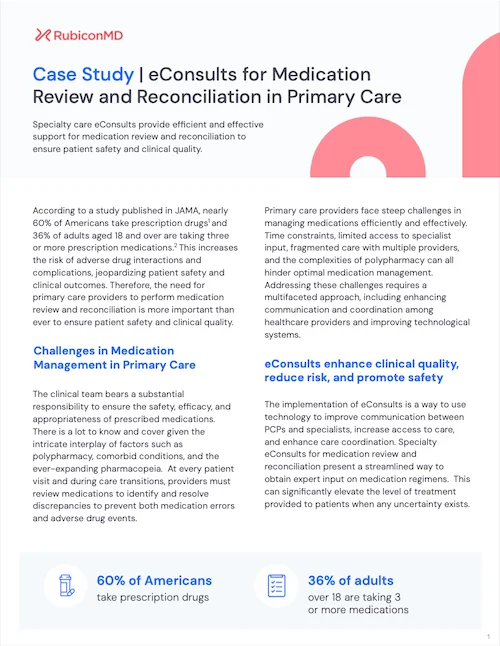
Explore real examples of specialty care eConsults providing efficient and effective support for medication review and reconciliation.