Expanding on the Vision for Value-Based Care: How eConsults Can Help Realize Better Outcomes
Value-based care must be central to the future of the U.S. healthcare system — reducing cost, improving outcomes, and most…
The Program of All-Inclusive Care for the Elderly (PACE) plays a vital role in helping older adults remain in their communities rather than in institutional care. Yet, as the healthcare landscape grows more complex with increasing competition from Medicare Advantage and expanding regulatory scrutiny, PACE organizations face mounting pressure to maintain compliance, deliver high-quality care, and operate efficiently as both payers and providers.
One key challenge: meeting the stringent requirements outlined in 42 CFR Part 460, which mandate timely access to specialty services, comprehensive care coordination, and robust quality improvement programs.
By connecting PACE clinicians to a nationwide network of virtual specialists, eConsults help organizations meet regulatory expectations while improving participant outcomes and optimizing resources.
Below are five key ways virtual specialty support helps PACE programs achieve compliance and operational excellence.
Under 42 CFR 460.70, PACE organizations must ensure participants receive medically necessary specialty services—even when direct contracts with local specialists aren’t available. In practice, this can be difficult due to provider shortages, scheduling challenges, and the geographic dispersion of participants.
eConsults offer a compliant and efficient solution. They connect primary care providers to board-certified specialists who can review cases asynchronously. This enables timely, expert input without requiring an in-person referral—helping PACE programs meet regulatory mandates while reducing care delays and unnecessary hospitalizations.
PACE programs rely on the Interdisciplinary Team (IDT) model, where physicians, nurses, social workers, and therapists collaborate to build holistic care plans. Integrating virtual specialists into this structure enhances care coordination by bringing expert insights directly into the IDT workflow.
With eConsults, care teams can review complex cases collectively, align treatment plans, and avoid fragmented or redundant care—all while documenting these processes for compliance reporting.
PACE organizations are required to operate continuous quality assessment and performance improvement (QAPI) programs. Virtual specialist input supports these efforts by helping identify care gaps, benchmark outcomes, and develop evidence-based interventions.
For compliance teams, eConsult data can serve as an auditable record demonstrating how clinical decisions were informed by specialist expertise—strengthening oversight and mitigating regulatory risk.
Timely access to specialty care is a major driver of reduced emergency visits and avoidable hospitalizations—two critical measures of PACE success. By using eConsults to manage chronic and complex conditions proactively, PACE teams can deliver high-quality care in the community setting, aligning with the program’s mission and CMS expectations.
Successful adoption of eConsults isn’t just about technology—it’s about alignment. PACE organizations need structured implementation plans, stakeholder engagement, and clear definitions of success.
RubiconMD partners with PACE programs to:
Real eConsult Transcripts for PACE Patients:
Case Study 1: A PCP seeks medication management guidance for an 82 yo female PACE patient experiencing agitation, feelings of aggression, restlessness, and who sees people who are not there. A RubiconMD specialist provides recommendations for pharmacotherapy and care plan strategies | Read the transcript
Case Study 2: A PCP requests medication for a 73 yo female medicare patient with 10+ year history of depression, anxiety and difficulty sleeping. A rubiconMD psychiatrist specialist provided evidence-based treatment to avoid an unneeded in-person referral | Read the transcript
These steps transform virtual specialty access from a “nice-to-have” tool into a clinically and regulatory-relevant resource that drives compliance and quality simultaneously.
PACE organizations face an increasingly complex regulatory environment. Virtual specialty consultation platforms like RubiconMD empower them to meet CMS standards, strengthen care coordination, and enhance the quality of care—all while supporting participants’ ability to live independently and safely in their communities.
As PACE continues to expand, virtual specialists aren’t just a convenience—they’re a compliance and quality imperative.
Value-based care must be central to the future of the U.S. healthcare system — reducing cost, improving outcomes, and most…
CHICAGO, IL — RubiconMD, the leading technology platform providing access to specialist expertise, today announced it has delivered one million…
The Program of All-Inclusive Care for the Elderly (PACE) plays a vital role in helping older adults remain in their…
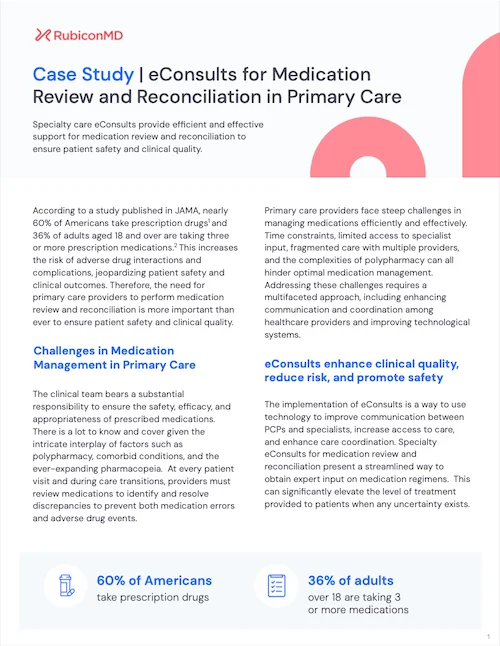
Explore real examples of specialty care eConsults providing efficient and effective support for medication review and reconciliation.